
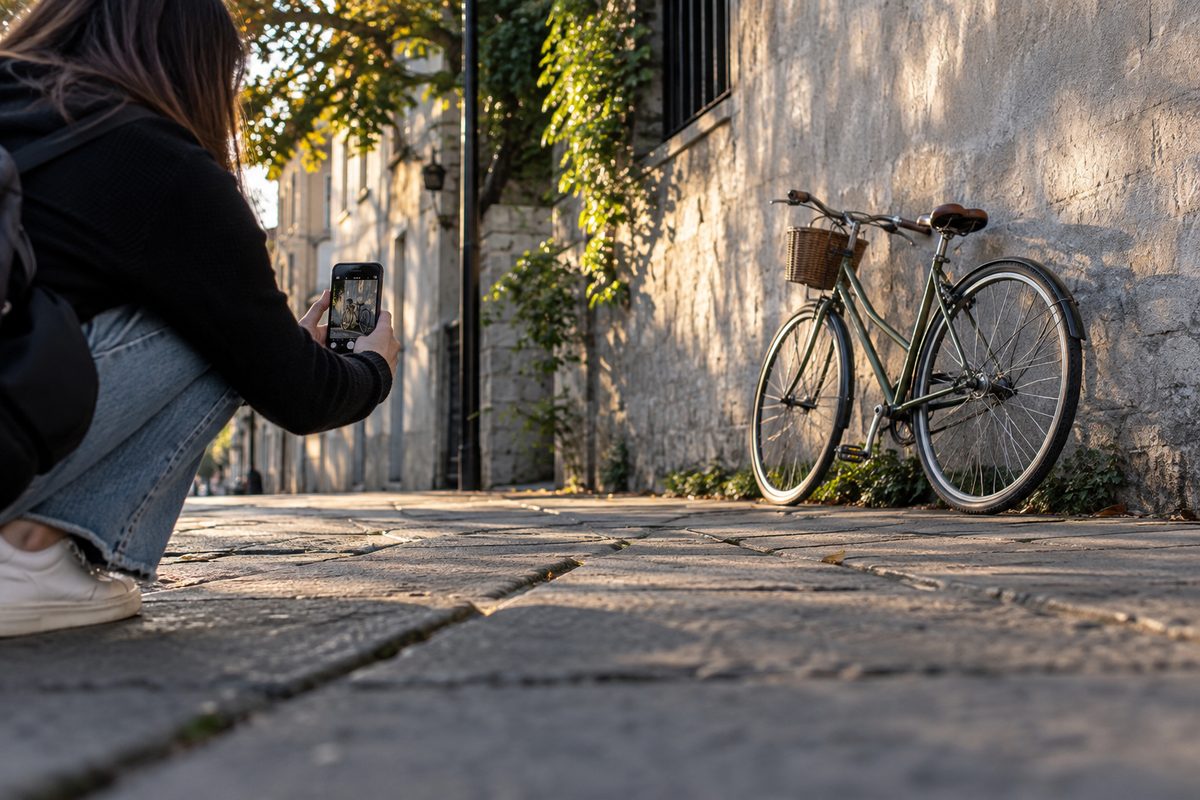
Move your smartphone 50 centimetres lower and you can end up with a surprisingly different photograph.
You haven't changed the camera. You haven't changed the subject. You may not have changed any settings at all.
But the foreground gets larger. The horizon moves. The background changes. A car can suddenly look more substantial, a dog feels closer to the viewer, and an ordinary street can become much more interesting.
Camera height is one of those things that's easy to overlook because most of us begin taking photographs from exactly the same place: wherever the phone happens to be when we lift it towards our face.
That's usually somewhere around chest or eye height.
There's nothing wrong with that height. The problem is using it for everything.

The Camera Doesn't See the Scene From Where You Do
Imagine you're standing in front of a dog in a park.
You can look down at the dog and still understand the whole environment around it. Your eyes move. Your head moves. Your brain builds a much broader impression of the scene.
A photograph doesn't do that.
It records the scene from one fixed position.
If the smartphone is 1.6 metres above the ground, the photograph is built from that 1.6-metre viewpoint. Lower it to 30 centimetres and the relationship between almost everything in the frame changes.
This is why moving the camera can sometimes have a greater effect than changing a camera setting.
Low Doesn't Automatically Mean Better
Low-angle smartphone photographs can look dramatic, which is probably why the technique gets recommended so often.
But putting the phone near the ground isn't automatically an improvement.
What you're really doing is changing the relationship between the subject, foreground and background.
At a low camera height, objects close to the ground become more important.
Grass can fill the foreground. Road markings become stronger lines. The wheels of a car become more prominent. Buildings appear to rise higher into the frame.
Sometimes that's exactly what you want.
Other times you've just created a photograph containing an enormous amount of pavement.
Look at What Happens to a Car
Cars make the difference particularly easy to see.
Photograph a car while standing normally and you're looking slightly down at much of the vehicle. You see more of the bonnet and roof.
Lower the smartphone towards knee height and the balance changes.
The wheels occupy more of the frame. The side of the vehicle becomes more visible. You may see less of the ground behind it and more of the distant environment or sky.
The car hasn't become larger, but its relationship with the camera has changed.
Go extremely low and very close with an ultra-wide camera and the effect becomes much stronger again. The nearest corner may appear exaggerated while the far end of the car recedes.
That can look dramatic, but it can also distort the vehicle more than you intended.

Eye Level Creates a Different Relationship With People and Animals
Camera height isn't only about making things look dramatic.
Sometimes it's about making the photograph feel more connected to the subject.
This becomes obvious with children and pets.
An adult standing with a smartphone naturally photographs a small dog from above. The ground becomes the main background and we're looking down onto the top of the animal.
Crouch until the phone is around the dog's eye level and the photograph changes.
Now the background may contain trees, buildings, other people or the horizon. We see the animal from a viewpoint much closer to its own world.
The same principle works when photographing children.
It doesn't mean every photograph needs to be taken at eye level. A photograph from above can be useful when you deliberately want to show scale or environment.
The important part is choosing the height instead of accepting the default one.
Higher Angles Reveal Relationships Between Objects
Move the smartphone upward and something else happens.
Instead of objects overlapping each other, you begin to see how they're arranged across the ground or another surface.
That's one reason overhead photography works so well for certain subjects.
A breakfast table photographed from normal seated height shows plates, cups and food overlapping one another.
Move directly above the table and their positions become much clearer.
The photograph becomes more about shape and arrangement than depth.
This works for tools on a workbench, travel gear on a hotel bed, ingredients on a kitchen counter, products on a table and many other everyday subjects.
But Straight Overhead Isn't Your Only Choice
There is a large amount of useful space between eye level and completely overhead.
Food is a good example.
A burger with several visible layers may look more interesting from a lower 30–45 degree angle because you can see its height.
A plate containing several colourful ingredients arranged across a flat surface may work better from above.
Neither angle is universally correct.
The camera height should help explain the shape of whatever you're photographing.

Camera Height Also Changes the Background
This is one of the most useful reasons to move the phone.
Suppose you're photographing someone standing in a busy location.
At eye height, the background might contain cars, signs, bins and dozens of people.
Lower the phone slightly and you may replace some of that visual clutter with sky or the upper part of a building.
Raise the phone and angle it down, and you might replace the distant background with a much simpler pavement or floor.
You haven't removed anything from the location.
You've simply changed what sits behind the subject.
Try Moving the Phone Before Moving the Subject
When a composition isn't working, we often start rearranging things.
Move the product. Move the chair. Ask the person to stand somewhere else.
Before doing that, move the phone.
Ten centimetres left.
Twenty centimetres lower.
A little higher.
Take one step backwards.
Small changes can separate objects that were overlapping or hide something distracting behind the subject.
This is particularly useful when you don't control the environment.
Very Low Angles Need a Little More Attention
One practical problem with low-angle smartphone photography is that it can become difficult to see the screen.
You may also find yourself kneeling on wet grass, sand or pavement just to get the camera into position.
For static subjects, a small tripod or adjustable phone mount can make experimenting with unusual camera heights easier.
A flexible arm such as the ROODTUO LCH3 Flexible Arm Clamp can also be useful when you want to position a smartphone above, below or beside a fixed surface without holding it continuously.
For more conventional low or elevated positions, you can also browse ROODTUO Tripods & Stands.
Don't Confuse Camera Height With Camera Tilt
These two things often happen together, but they're not the same.
You can lower the smartphone while keeping it relatively level.
Or you can stand normally and point the phone dramatically upwards.
Those photographs won't look the same.
Tilting changes where the camera points and can make vertical lines converge strongly. Changing camera height changes the physical viewpoint from which the scene is being observed.
If you're experimenting, try changing one thing at a time.
Lower the phone without dramatically tilting it and see what changes. Then try the same height with a different tilt.
You'll understand the effect much faster than trying to memorise a rule.
Ultra-Wide Makes Height Changes More Obvious
The wider the camera, the more noticeable perspective differences can become when something is close to the lens.
Put an ultra-wide smartphone camera very close to the ground and nearby pavement, grass or another foreground object can become enormous compared with the background.
That can create a strong sense of depth.
It can also become a gimmick if every photograph uses the same exaggerated foreground.
Try the main camera first. Then switch to ultra-wide and compare what changed.
The interesting part isn't deciding that one lens is better. It's understanding how camera position and lens choice work together.
One Location, Five Heights
Here's a simple experiment worth trying the next time you're outside.
Choose one ordinary subject. It could be a parked bicycle, a bench, a tree, a car or even a coffee cup on an outdoor table.
Don't move the subject.
Take five photographs:
- Phone almost touching the ground or table
- Around knee height
- Around waist height
- Normal eye height
- As high as you can comfortably and safely hold it
Don't worry about making every photograph beautiful.
Look at them together afterwards.
Which one shows the most foreground?
Where does the horizon move?
Which background is cleanest?
When does the subject feel largest?
When do you understand the surrounding environment best?
You'll probably learn more from those five photographs than from reading another list of camera settings.
The Best Height Depends on What You're Trying to Show
There isn't one correct camera height for smartphone photography.
If you want to show the height of a sandwich, completely overhead probably isn't ideal.
If you want to show how several dishes are arranged across a table, overhead might be exactly right.
If you want a dog portrait that feels personal, eye level is worth trying.
If you want to emphasise a car's wheels and body lines, a lower position may work better.
If you want to show where everything is positioned in a workspace, moving higher can simplify the scene.
The question isn't really, "What's the best angle?"
It's, "What do I want the viewer to notice?"
Final Thoughts
Smartphone photography makes it very easy to think about the screen before thinking about where the screen actually is.
Next time a photograph feels ordinary, don't immediately open the camera settings.
Move the phone.
Put it lower than you normally would. Raise it. Step sideways. Look at what happens to the foreground and background.
You may find that the biggest change to the photograph has nothing to do with the camera inside your phone.
It came from moving the phone itself.
Share:
How to Film Better Videos Through a Car or Train Window